Bringing the wrong pump into a Zone 1 area is a stop-work issue, sometimes a regulatory finding, occasionally an incident. An ATEX air torque pump exists because the pumps driving hydraulic torque tools must be safe to operate in the atmospheres where the bolting work happens: refineries, offshore platforms, petrochemical plants and mines.
The pump is pneumatic, so there is no electrical ignition source. It carries the Ex marking and a notified-body certificate proving it meets the ATEX Directive 2014/34/EU. That certification is the difference between a pump that can legally drive a torque wrench on a refinery flange and one that stays in the depot.
What ATEX certification means
ATEX is the European Directive 2014/34/EU, which governs equipment intended for use in potentially explosive atmospheres. The directive defines the certification process for manufacturers and the obligations placed on employers who put that equipment to work.
In Great Britain, the same technical requirements apply under Statutory Instrument 2016 No. 1107, with the Health and Safety Executive as the enforcing authority under DSEAR. See the HSE guidance on DSEAR and ATEX for site duty of care.
For hydraulic torque pumps, the practical implications are these:
- The pump motor is pneumatic, not electric. Compressed air drives a piston or vane motor. There are no brushes, sparks or electrical heating elements.
- Sliding and rotating components are designed to prevent friction sparking. This is typically achieved through material selection, including non-ferrous components in critical contact areas, and clearances that prevent metal-on-metal contact.
- Surface temperatures are controlled. Under fault conditions, they must remain within the temperature class specified on the certificate, from T1 to T6. T6 is the most conservative, with a maximum surface temperature of 85 degrees Celsius.
- The whole assembly carries the required markings. This includes the CE or UKCA mark, the Ex marking and a certificate documenting the testing it has been through.
A pump without these markings cannot legally be used in an ATEX-classified area, regardless of how robust or well-built it appears.
ATEX, IECEx and the UK regulation
ATEX, under Directive 2014/34/EU, is the European certification scheme. IECEx is the international scheme run by the IEC and is used across most non-EU markets.
In Great Britain, the same technical requirements apply under SI 2016 No. 1107, with equipment carrying the UKCA mark alongside or in place of CE. Northern Ireland continues to accept CE marking under the Windsor Framework. The term “UKEX” is used informally by some suppliers but is not an official EU-style scheme name.
Equipment frequently carries several certifications, particularly tooling intended for the global oil and gas supply chain. When specifying a pump, check that the certificate covers the jurisdiction where the work is performed, not simply the country where the pump was purchased.
Reading the zone markings
ATEX uses two parallel zoning systems: one for gas and vapour atmospheres and another for combustible dust.
Gas and vapour zones
- Zone 0. An explosive atmosphere is present continuously or for long periods.
- Zone 1. An explosive atmosphere is likely to occur during normal operation.
- Zone 2. An explosive atmosphere is not likely to occur and, if it does, will exist only briefly.
Most refinery and petrochemical flange-bolting work falls within Zone 1 or Zone 2.
Dust zones
- Zone 20. A combustible dust atmosphere is present continuously.
- Zone 21. A combustible dust atmosphere is likely during normal operation.
- Zone 22. A combustible dust atmosphere is not likely to occur and, if it does, will be present only briefly.
Mining and certain power-generation environments operate in dust zones because of methane release or combustible-dust risk.
A pump rated for Zone 1 may also be used in Zone 2, but a Zone 2-only pump cannot be used in Zone 1.
The RWP55 series uses the current EN ISO 80079-36 marking format:
h IIB T6 Gb IIIB T100°C Db
Reading from left to right:
- h. Non-electrical protection level, replacing the older constructional-safety letter “c”.
- IIB. Gas group covering ethylene and gases with similar volatility. IIB equipment is also permitted in IIA atmospheres, including propane and methane, but not in IIC atmospheres such as hydrogen and acetylene, which require more stringent protection.
- T6. Maximum surface temperature of 85 degrees Celsius, the most conservative temperature class.
- Gb. Equipment Protection Level for gas Category 2, permitting use in Zone 1 and Zone 2.
- IIIB. Dust group covering non-conductive combustible dust.
- T100°C. Maximum surface temperature under fault conditions in a dust atmosphere.
- Db. Equipment Protection Level for dust Category 2, permitting use in Zone 21 and Zone 22.
Older equipment nameplates may still show the pre-2016 format, such as Ex II 2G c IIB T4, with an explicit category number and the letter “c” for constructional safety. Both formats remain valid in the field and must be honoured against the site zone classification.
Industry applications
ATEX air torque pumps are typically used in the following industries and applications:
| Industry | Typical application |
|---|---|
| Oil and gas | Flange tightening on pipelines, valve maintenance and wellhead assembly in refineries and offshore platforms. |
| Petrochemical | Bolting on reactors, heat exchangers and storage tanks during plant construction and shutdowns. |
| Chemical processing | Securing process equipment where volatile chemicals are present. |
| Mining | Equipment maintenance in areas where flammable gases such as methane are present, including ATEX Group I firedamp environments. |
| Power generation | Maintenance of turbines and boilers where fuel vapours are a concern. |
| Pharmaceutical | Reactor and vessel maintenance where solvent vapours fall within Zone 1 or Zone 2 during specific operating phases. |
Standard vs double-flow air torque pumps
Standard air torque pumps
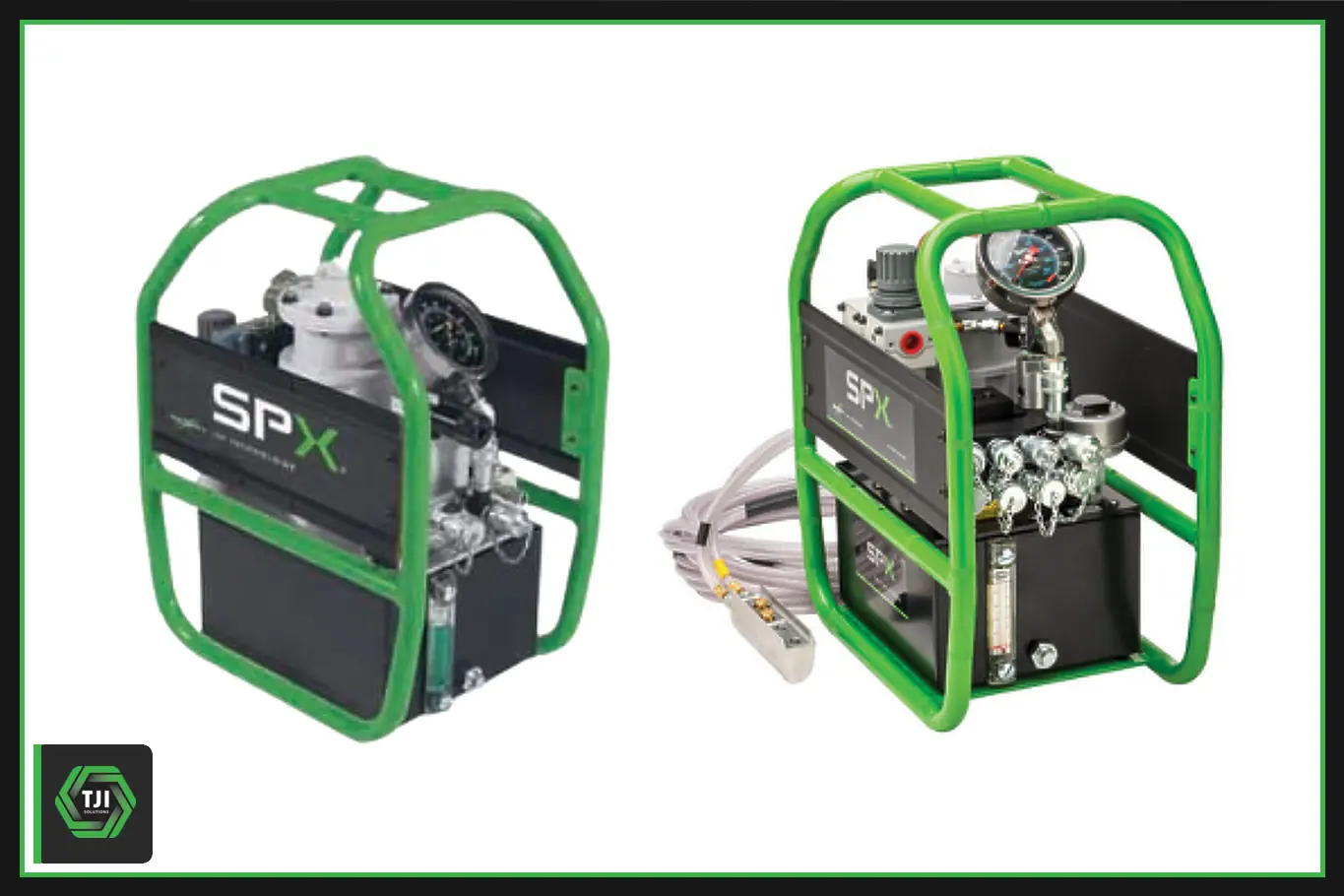
TJI’s ATEX hire fleet is built around the SPX / Hydraulic Technologies RWP55 series, an air-driven hydraulic pump platform used across offshore, refinery and shutdown work in the UK and North Sea.
Standard-flow variants deliver a continuous flow at working pressure up to 700 bar, or 10,000 psi. They are suited to smaller tools, lower bolt counts and applications where cycle time is not critical.
The certificate covers the RWP55 base pump and its principal variants, including RWP55-BS, RWP55-BS-R, RWP55-DUAL, RWP55-IBT-AIR and RWP55-TL, under ATEX 2014/34/EU and UK SI 2016 No. 1107. Technical File Sira 14XT237 is held by CSA Group Netherlands.
Double-flow air torque pumps
Double-flow air torque pumps combine a high-flow, low-pressure stage for the initial fast-fill of the tool with a low-flow, high-pressure stage for the final torque or tensioning load.
The result is a significant reduction in cycle time on tools with a large hydraulic volume. On a flange with 80 bolts, the difference across a shift is material. For shutdown work where every minute on the platform counts, double-flow equipment can justify its premium within a single job.
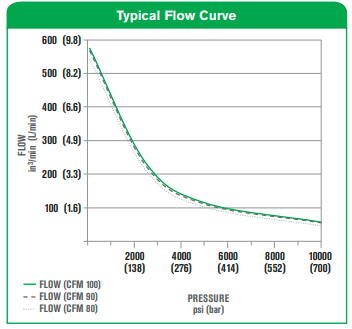

Figure 1. Flow-curve comparison: RWP55 double-flow vs standard-flow. Left: the RWP55 double-flow characteristic with three CFM input variants at 80, 90 and 100. Flow tapers gradually across the pressure range, sustaining cycle speed on large-volume tools. Right: the RWP55 standard-flow characteristic. Flow drops sharply after the initial fill and is best suited to smaller tools and lower bolt counts. Source: Hydraulic Technologies RWP55 datasheet.
Air supply requirements
ATEX air pumps depend on a clean, dry compressed-air supply at adequate volume.
Typical requirement for the RWP55 series: 5 to 7 bar (70 to 100 psi) inlet pressure with around 45 CFM (roughly 1,275 litres per minute) of free-air delivery for the larger pumps. Where the double-flow variant is used at its highest output, the datasheet curves show performance at 80, 90 and 100 CFM inputs but 45 CFM remains the typical baseline for standard operation.
Two practical issues are regularly encountered by TJI’s hire fleet:
- Shared compressors may not deliver their rated flow. Site compressors are often shared with other tools and may not provide the required pressure and air volume when several users are connected to the same line.
- Cold conditions can increase air-line water content. An inline air dryer is worth specifying for winter shutdowns in the North Sea or northern Europe.
What TJI supplies
TJI’s hire fleet includes ATEX-certified standard and double-flow ATEX air torque pumps rated for Zone 1 and Zone 2 gas atmospheres, with the marking h IIB T6 Gb.
The equipment is also rated for Zone 21 and Zone 22 combustible-dust atmospheres, with the marking IIIB T100°C Db. This covers the majority of hazardous-area bolting scenarios encountered by TJI clients.
Each unit ships with:
- The current ATEX Declaration of Conformity, Revision 04, October 2025.
- Current pressure-gauge calibration service certification.
- Hoses and couplings matched to the hydraulic torque wrench being used on the job.
Certification documents: The current ATEX Declaration of Conformity for the RWP55 series, Revision 04 dated 7 October 2025, is supplied with every hire and is available on request. Technical File Sira 14XT237 is held by CSA Group Netherlands B.V. in Arnhem.
Planning bolting work in a classified area
If you are planning bolting work in an ATEX-classified area, request a quote from TJI Solutions with the zone classification and the tool you intend to drive. The team will confirm a matched, certified kit.